A second-sphere coordination compound [Co(DABP)3][Fe(CN)6] (1) (DABP=5,5′-diamino-2,2′-bipyridine) was obtained via the self-assembly of [Fe(CN)6]3- anions and [Co(DABP)3]3+ cations by the Research Group of Organic Polymer Materials, State Key Laboratory for Oxo Synthesis and Selective Oxidation, Lanzhou Institute of Chemical Physics (LICP), CAS. [Fe(CN)6]3- anions and [Co(DABP)3]3+ are arranged alternately into a linear chain linked by charge-assisted N–H(NH2)…N(CN) hydrogen bonds. Researcher also obtained hexagonal microrods of 1 with uniform morphology and size via a facile surfactant-assisted self-assembly method.
In recent years the morphological control of materials has become an attractive objective because the physical, chemical and biological properties of the materials are often largely dependent on their shape and size. Although considerable effort has been dedicated to the controlled synthesis of micro and nanoscale particles with classical inorganic structures, formation of micro- and nanoscale materials based on supramolecular compounds has rarely been studied. Very recently, increasing attention has been paid to the investigation of supramolecular compounds in the micro- and nanosize regime, such as the nanoscale metal–organic frameworks (NMOFs). The limited solution-based behavior of MOFs may be overcome, to some extent, by the preparation of nano- and microscale materials. NMOFs can be obtained by many methods, among which the surfactant assisted self-assembly is one of the most effective methods to control the morphology and architecture of the functional material. The surfactant acting as a capping reagent plays an important role in the process of self-assembly or oriented aggregation, facilitating the formation of special morphologies to reduce the surface energy and thus the total system energy through the dipole–dipole interaction or van der Waals forces.
Hydrogen bonding is an important aspect in supramolecular assembly due to its combination of strength and directionality. Second-sphere coordination, i.e. interaction between already coordinatively saturated metal complexes and external ligands through hydrogen bonding, is an efficient and convenient way to construct hydrogen-bonded frameworks. Although nano-systems organized on surfaces by means of H-bonds is a hot topic, most of these examples are restricted to organic building blocks (without metals) and there has been a paucity of investigation on micro- or nanoscale hydrogen-bonded frameworks with special shapes.
The work was supported by the National Natural Science Foundation of China . The research result was published in the recent issue of Chem. Commun. (Chem. Commun., 2010, 46, 1121–1123).
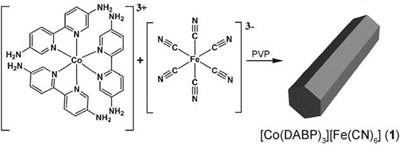
Preparation of highly uniform hexagonal rods of 1 with an average diameter of ca. 400 nm and length of 5 mm in the presence of the polyvinylpyrrolidone (PVP) surfactant.
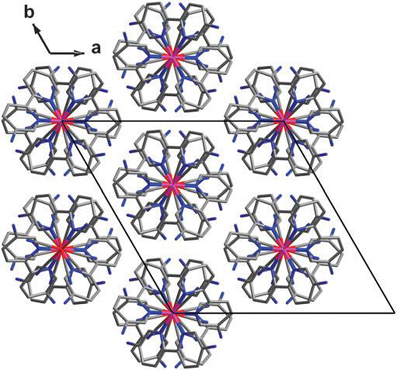
Packing diagram of 1 viewed from the c-axis showing the arrangement of seven neighboring chains.


