


Abstract
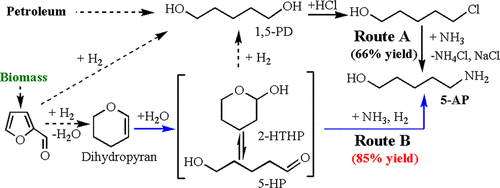
The reductive amination (RA) of 2-hydroxytetrahydropyran (2-HTHP) produced from biofurfural-derived dihydropyran provides a new efficient process for the clean synthesis of valuable 5-amino-1-pentanol (5-AP). Among various solid catalysts tested, the inexpensive Ni-Mg3AlOx catalysts derived from hydrotalcite precursors were found to be very active and selective, especially at Ni loadings above 20 wt %. A 85% total yield of 5-AP was obtained from dihydropyran on 40Ni-Mg3AlOx, the catalyst with the highest 2-HTHP RA activity among the Ni-Mg3AlOx catalysts, under mild conditions of 60 degrees C and 2 MPa H-2. Characterization results showed that the reducibility of the calcined NiO-Mg3AlOx samples increased with increasing Ni loading from 5 to 50 wt %, while the Ni0 crystallite sizes exhibited a minimum of 4.8 nm on 40Ni-Mg3AlOx after reduction in H-2 at 750 degrees C. The volcanic changes of 5-AP generation rate/yield with increasing Ni loading of the Ni-Mg3AlOx catalysts and with rising prereduction temperature of 30Ni-Mg3AlOx catalyst in 2-HTHP RA indicate that the balance of the reducibility and Ni-0 particle size of the catalysts played an important role in obtaining high 5-AP yields. The 30Ni-Mg3AlOx catalyst showed a good stability in 2-HTHP RA examined in a continuous flow reactor over a 90 h time-on stream.
KeyWords Plus:REDUCTIVE AMINATION; HYDROGEN-PRODUCTION; METHANE DECOMPOSITION; PRIMARY AMINES; NI; MG; 1,5-PENTANEDIOL; NANOPARTICLES; AMMONIA
Published in ACS SUSTAINABLE CHEMISTRY & ENGINEERING,Volume 8;10.1021/acssuschemeng.0c00394,APR 27 2020