


Abstract
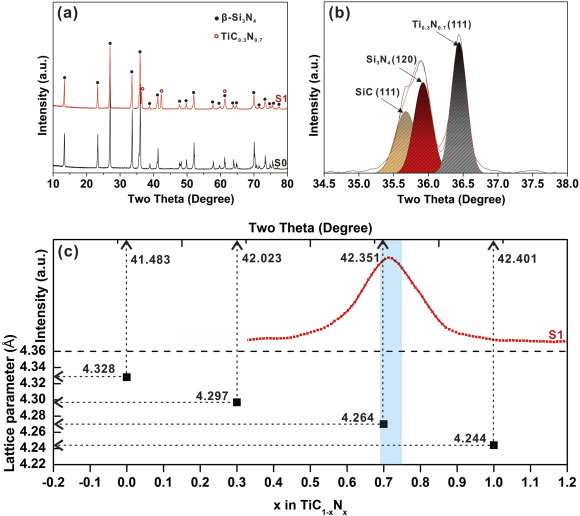
In this work, a dense Si3N4-based composite was fabricated by spark plasma sintering the mixture of Si3N4 and TTi3AlC2. The nitrogen atoms of Si3N4 diffused into the TiC, lattice and leaded to the in-situ formation of TiC0.3N0.7 and SiC compounds. After annealing in air at 900 degrees C, TiC0.3N0.7 was oxidized to form rutile-TiO(2 )particles (about 3-4 mu m). Meanwhile, it was found that the oxidized composite displayed superior mechanical and tribological properties, compared to Si3N4 and Si3N4-based composite before oxidation. Typically, the fracture toughness reached 9.97 MPa m(1/2), which was 59.5% higher than that of Si3N4. In addition to cracks branch, bridge and deflection, the surface barrier of oxides was another major toughening mechanism. Besides, due to the pinning effect of TiC0.3N0.7, sliding-induced microcracks were completely suppressed, and the composite exhibited excellent friction and wear performances. In this case, the composite is expected to be fabricated into ceramic parts for service in high temperature environment.
KeyWords Plus:SELECT MAX PHASES; TRIBOLOGICAL BEHAVIOR; MECHANICAL-PROPERTIES; THERMAL-CONDUCTIVITY; MICROSTRUCTURE; CERAMICS; DENSIFICATION; COMPOSITES; AL2O3; WEAR
Published in CERAMICS INTERNATIONAL,Volume 46;10.1016/j.ceramint.2020.02.273,JUL 2020