


Abstract
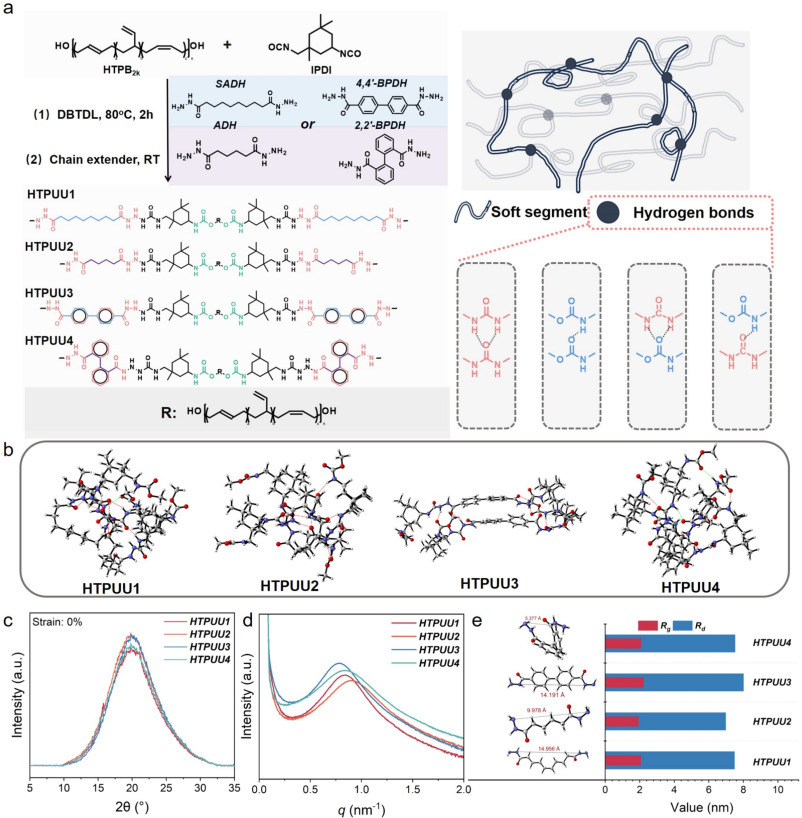
Elastomeric seals play a critical role in preventing fluid leakage while simultaneously dampening vibrations and insulating sound within mechanical systems. For extreme cold applications, elastomeric seals require maintained strength, elasticity, and stability from cryogenic to room temperature (RT). Conventional cryogenic elastomers use flexible molecular chains for cold-weather performance. This preserves cold elasticity but reduces room-temperature strength and creep resistance, limiting overall performance. To address this challenge, we designed a hydroxyl-terminated polybutadiene (HTPB)-based poly(urethane-urea) elastomer (HTPUU) through strategic modulation of chain extender rigidity and construction hierarchical hydrogen bonding. This molecular design achieves concurrent cryogenic stability (T-g similar to -70 degrees C, operational range -90 degrees C to RT) and mechanical robustness through hydrogen-bonding-mediated nanophase separation, where acylsemicarbazide (ASCZ)/carbamate nanodomains serve as multifunctional elements that both crosslink the polymer networks and reinforce the matrix. The dynamic hydrogen-bonding-mediated nanophase separation effectively suppress low-temperature crystallization in HTPB segments. Comparative evaluations demonstrate that the HTPUUs outperform both conventional rubbers and previously reported low-temperature elastomers in both mechanical properties and cryogenic adaptability. These characteristics establish HTPUU as a highly promising candidate for advanced low-temperature sealing applications.
Keywords Plus: MOLECULAR-DYNAMICS,GLASS-TRANSITION,TEMPERATURE,POLYURETHANE,CRYSTALLIZATION,VERSATILE,MONOMERS,DESIGN,RUBBER,AGENT
Published in CHEMICAL ENGINEERING JOURNAL,Volume524;10.1016/j.cej.2025.169072,NOV 15 2025