


Abstract
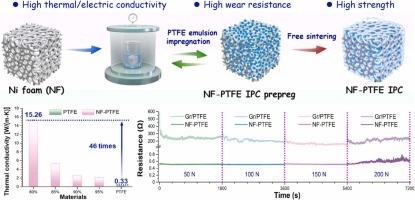
The development of interpenetrating phase composites (IPCs) is promising, while their applications were typically limited by insufficient mechanical, thermal and lubricating performance. Here, a metal-polymer IPC was fabricated by interpenetrating 3D open-cell nickel foam (NF) with polytetrafluoroethylene (PTFE) emulsion. The results show that the optimal material structure, especially the decreasing porosity of NFs, generally improves the mechanical, thermal and wear properties. At 80 % NF porosity, the maximum tensile strength reaches 50.4 +/- 6.8 MPa, which is 41 % higher than that of PTFE, and a thermal conductivity of up to 15.26 W/(m center dot K) is simultaneously obtained, being similar to 46 times greater than that of PTFE. The wear rate is reduced by one order of magnitude compared with that of pure PTFE, owing to the increased load capacity and thermal dissipation. Moreover, the electrical resistance of developed IPC is less than 1 Omega under different loads during dynamic wear, which is expected to be applied as multifunctional lubricating materials.
Keywords Plus: TRIBOLOGICAL BEHAVIOR,THERMAL-CONDUCTIVITY,PTFE
Published in TRIBOLOGY INTERNATIONAL,Volume214;10.1016/j.triboint.2025.111346,FEB 2026