


Abstract
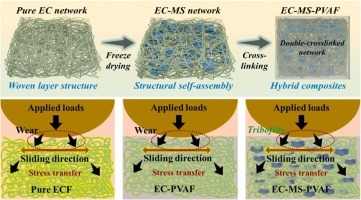
Herein, waste MXene sediments (MS) from MAX etching process was integrated into esterified nanocellulose (EC) woven layers via ice-template and solvent evaporation-induced self-assembly strategies. Dual-crosslinking of ECPVA eliminate interface defects, making composites with stable interfaces. Chemical crosslinking, hydrogen bonds interaction, physical interlocking, and van der Waals forces synergistically enhanced the mechanical stress transfer and frictional energy dissipation capability, thus achieving the high strength, low friction, and environmental stability. Tribological tests demonstrate that the rigid EC framework combined with the flexible PVA chains allows the EC-woven network to effectively store MS, enabling it to exhibit flexible variability for transmitting frictional stress, and release MS at the frictional interface to participate in the tribofilm formation and reduce friction and wear.
Keywords Plus: FRICTION
Published in TRIBOLOGY INTERNATIONAL,Volume215;10.1016/j.triboint.2025.111383,MAR 2026