


Abstract
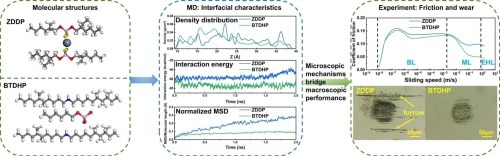
This study addresses the lubrication challenges of hybrid tribopair interfaces such as steel-Si3N4, where conventional additives optimized for steel-steel contacts underperform due to ceramic inertness. Combining molecular dynamics (MD) simulations with tribological experiments, four phosphate ester additives-TPPT, TCP, ZDDP, and BTDHP-were evaluated to elucidate their interfacial behaviors and anti-wear performance across kinematic regimes. MD results show that additive efficacy correlates with adsorption strength on steel surfaces; BTDHP exhibits the highest adsorption energy, forming a compact film that suppresses displacement fluctuations and promotes wall slip. Experiments confirm that BTDHP yields the lowest friction and wear, optimizing Stribeck transitions from boundary to hydrodynamic regimes. In contrast, ZDDP's reliance on reactive ZnS tribofilms causes shear instability and plowing under Si3N4 abrasion. A structure-property-performance model is proposed to correlate molecular adsorption and film stability with macroscopic tribological performance. This integrative framework connects atomic-scale insights with experimental evidence, providing a foundation for data-driven and AI-accelerated optimization of lubricant additives for hybrid interfaces.
Keywords Plus: FRICTION
Published in APPLIED SURFACE SCIENCE,Volume720;10.1016/j.apsusc.2025.165242,FEB 28 2026