


Abstract
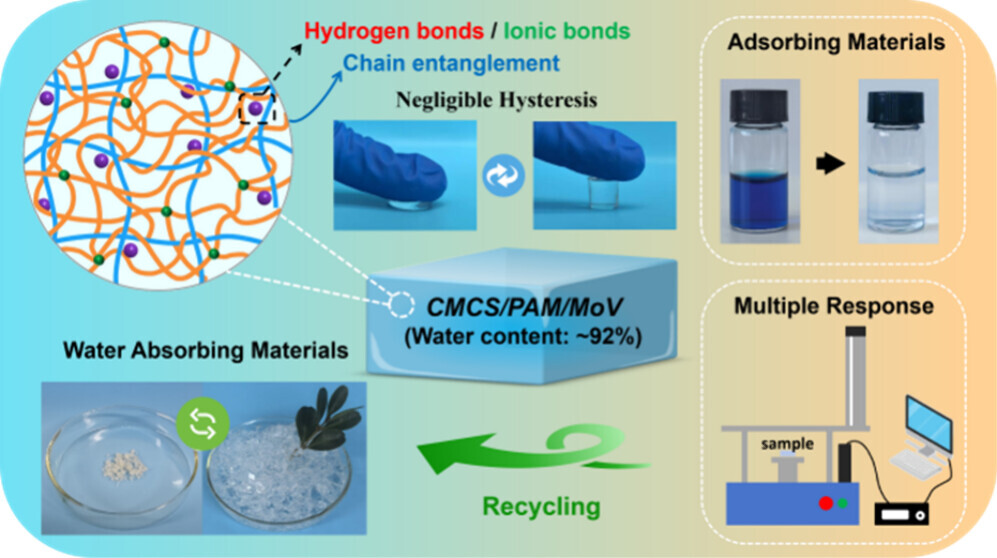
In the structure of hydrogels, nonchemical cross-linking structures (intermolecular interaction and chain entanglement), which are usually formed by some specific functional groups, significantly impact the mechanical properties. Leveraging these functional groups can impart unique application properties to the hydrogel. Herein, this paper combines the strategies of chain entanglement and polyoxometalates (POMs) to prepare carboxymethyl chitosan (CMCS)/polyacrylamide (PAM) hydrogels with interpenetrating networks in a one-step process. The introduced POMs have hydrogen bonding and electrostatic interactions with CMCS. The existence of plenty of physical cross-linking and chain entanglement structures enables the hydrogel to maintain outstanding tensile properties, negligible hysteresis, and high recovery under the conditions of high water content (similar to 92%). POMs doping effectively optimizes the conductivity of the hydrogel, and the presence of abundant functional groups in this system endows the material with multiple environmental responsiveness and adsorption properties (especially a significant adsorption capacity for microplastics). Further, alkaline hydrolysis allows hydrogel recycling into a super water absorbent material. These results indicate that POMs are a highly promising class of dopants, and these hydrogels have potential applications in flexible sensing, water monitoring, and water remediation fields.
Keywords Plus: POLYMERS
Published in ACS APPLIED MATERIALS & INTERFACES,Volume17;10.1021/acsami.5c18803,DEC 24 2025