


Abstract
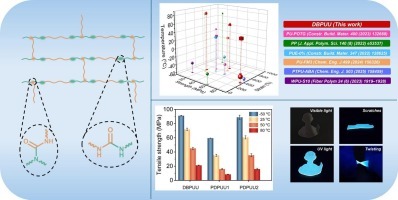
Maintaining excellent mechanical properties across a wide temperature range, particularly at low temperatures, is essential for elastomeric sealing materials. At lower temperatures, the soft segment domains of polyurethane (PU) tend to become immobilized, while the hydrogen bonds in the hard segment domains can easily dissociate, posing a significant challenge for PU to achieve superior mechanical performance under these conditions. Here, we introduced aromatic amines containing amide groups into the hard domains which not only facilitated the formation of stable yet dynamic crosslinked structures but also promoted the development of high-density hydrogen bonds, resulting in a specific hard segment cluster structure. The resulting polyurethane urea (PUU) demonstrated outstanding mechanical properties and toughness. Among them, DBPUU elastomers exhibited excellent mechanical properties, with a tensile strength of 71.82 MPa and elongation at break of 660 % at room temperature, and maintained high strength and toughness under extreme environments of -50 degrees C and 80 degrees C. Additionally, DBPUU possesses excellent solvent resistance and fatigue durability, making it particularly suitable for elastomeric sealing applications. This unique hard segment cluster structure also imparts luminescent properties and exceptional shape memory performance. This work provides a design strategy for high-strength, tough elastomeric sealing materials across a wide temperature range, while the multifunctionality of PUU expands its potential applications in anti-counterfeiting and information encryption.
Keywords Plus: REVERSIBILITY,ISOCYANATE,ELASTOMERS,BONDS
Published in CHEMICAL ENGINEERING JOURNAL,Volume527;10.1016/j.cej.2025.171699,JAN 1 2026