


Abstract
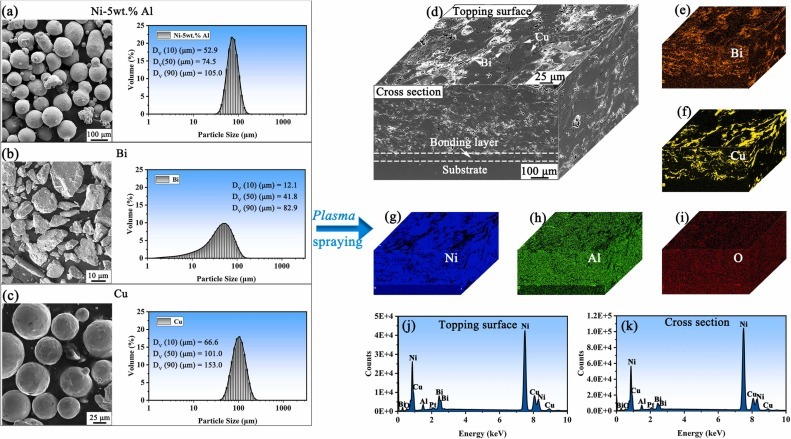
This study focuses on investigating the microstructure, phase evolution, and tribological behavior (RT, 400 degrees C and 800 degrees C) of (Ni-5 wt% Al)-Bi-Cu composite coating, aiming to clarify the synergistic effect of Bi and Cu. In-situ reactions during spraying generate NiBi3 (preferred due to its higher interdiffusion coefficient) and delta-Bi2O3 (kinetically trapped by rapid quenching after Bi oxidation). Tribologically, at RT, soft phases (Bi, Cu, delta-Bi2O3) form partial tribo-layers to alleviate friction and wear, but the brittle NiBi3 restricts the tribo-layer's functionality, leading to abrasive wear. At 400 degrees C, phase transformations (NiBi3-*NiBi, delta-Bi2O3-*alpha-Bi2O3) occur alongside partial Cu oxidation to CuO, which improves lubrication; meanwhile, Ni matrix creep leads to plastic deformation, and the wear reduction effect is yet to be fully optimized. At 800 degrees C, a hierarchical tribo-layer (a top CuBi2O4/CuO-rich nanocrystalline layer and an underlying NiO layer) forms. The spinel-structured CuBi2O4 (from the Bi2O3-CuO reaction) has a low shear modulus due to sublattice mismatch, enabling the coating to achieve excellent tribological performance (friction coefficient: 0.18; wear rate: 6.2 x 10⁻⁵ mm3 center dot N- 1 center dot m- 1), which are 54 % and 79 % lower than those of the pure Ni-5 wt% Al coating, respectively. Notably, the tribo-layer formed at 800 degrees C retains its anti-wear capability in subsequent RT/400 degrees C cycles. This research offers insights for optimizing lubricating coatings applied in fluctuating temperature environments.
Keywords Plus: BISMUTH,WEAR,EVOLUTION,OXIDE
Published in TRIBOLOGY INTERNATIONAL,Volume18;Volume217;10.1016/j.triboint.2025.111643,MAY 2026