


Abstract
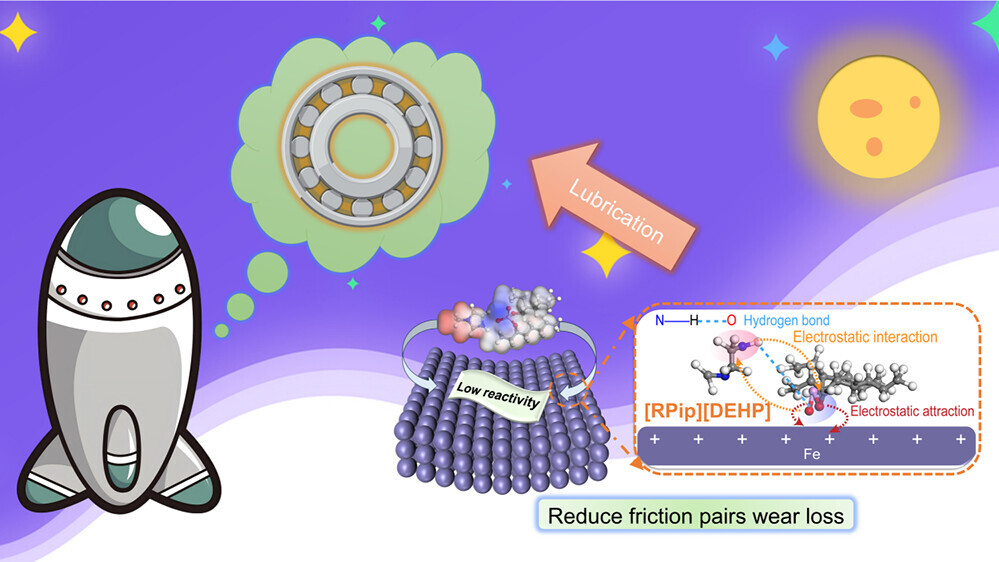
In the aerospace industry, many mechanical failures result from friction-related issues, which reduce component lifespans and lead to resource waste. Consequently, effectively reducing friction and achieving ultralow wear under extreme conditions, especially on bearing steels, remain a significant challenge. Currently, lubricants exhibiting high chemical reactivity are commonly employed to generate robust tribofilms on metal surfaces, thereby providing effective protection to the metal substrate. However, these intense friction-induced chemical reactions consume the substrate at the same time. Moreover, such reactive materials frequently cause corrosion, further compromising component durability. To address these issues, this study introduces innovatively a class of low-reactivity halogen-free piperazine-derived protic ionic liquids as neat lubricants. Compared to traditional space liquid lubricants, the synthesis methods of protic ionic liquids do not require high-temperature polymerization, making the preparation process more environmentally friendly and reducing energy consumption. The piperazine-derived protic ionic liquids exhibit noncorrosiveness toward metals and achieve an ultralow wear rate of 3.77 x 10⁻¹⁰ mm3 N-1 m-1. The formation of a mechanically robust interface effectively extends the service life of moving parts in harsh environments. These results highlight the promising application potential of low-reactivity PILs as space lubricants and provide a greener strategy for ultralow wear and corrosion resistance on bearing steel.
Keywords Plus: TRIBOLOGICAL PERFORMANCE,LUBRICANT ADDITIVES,CORROSION
Published in ACS SUSTAINABLE CHEMISTRY & ENGINEERING,Volume14;10.1021/acssuschemeng.5c10340,FEB 2 2026