


Abstract
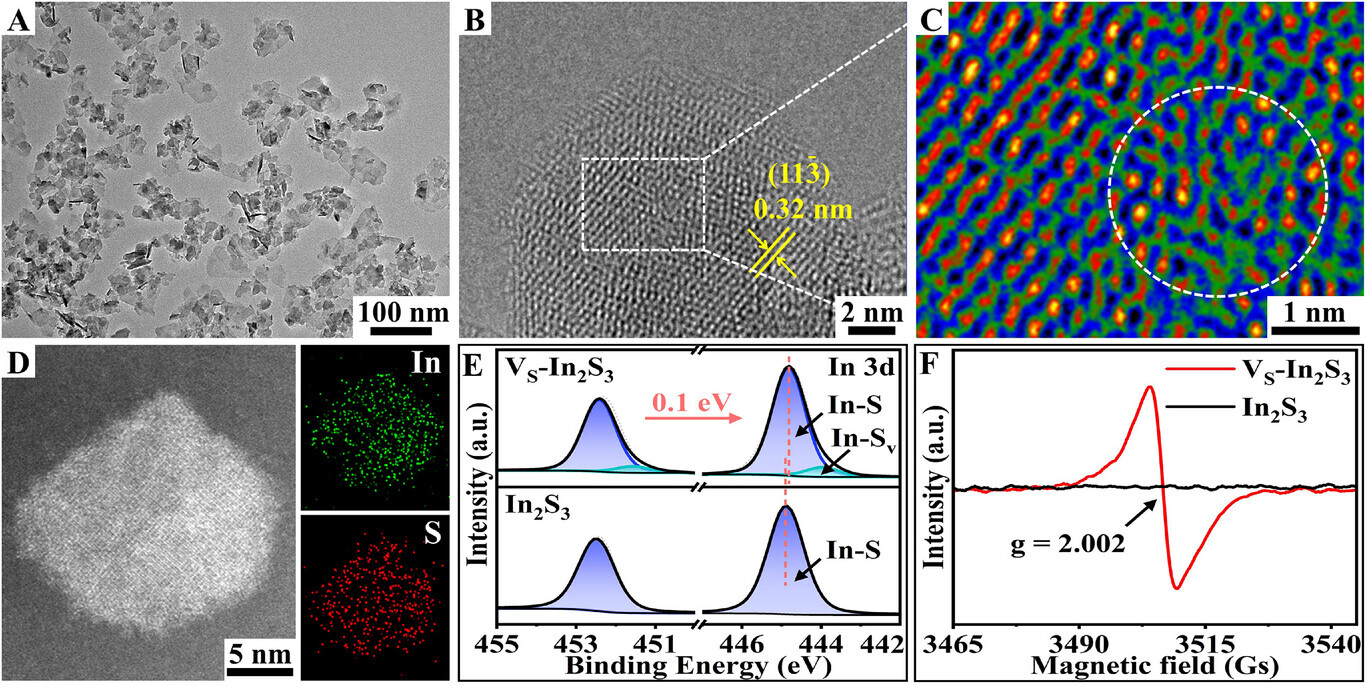
Defect engineering is a promising strategy in heterogeneous catalysis, while understanding how the defective sites affect reactivity still remains ambiguous. Herein, we demonstrated an in-depth experimental study of dynamic interaction of CO2 molecules on defective In2S3 surfaces by integrating operando X-ray photoelectron spectroscopy with infrared spectroscopy. More specifically, the formation of S vacancy could promote the electron enrichment on adjacent In sites for facilitating CO2 molecule adsorption, accompanying with the emergence of high oxidation states of surface In sites. Upon light illumination, the adsorbed CO2 molecules undergo a sequential transformation into *COOH and *CO intermediates. However, an unexpected upside-down inversion of *CO species on defective In sites from In-*CO to In-*OC has been firstly observed, severely restraining desorption of CO product from In2S3 surfaces. Further tailoring the electronic structure of defective In sites by substituting residual S atom with O atom for inhibiting *CO inversion, a significant improvement of CO evolution activity has been achieved (18.3 mu mol g-1 h-1), nearly five times higher than that of pristine In2S3 (3.77 mu mol g-1 h-1). This work provides the new insights on dynamic roles of defect-derived active sites in determining catalytic activity, which might offer opportunities for fine control of catalytic process.
Keywords Plus: REDUCTION,SELECTIVITY
Published in SMALL; 10.1002/smll.72704