


Abstract
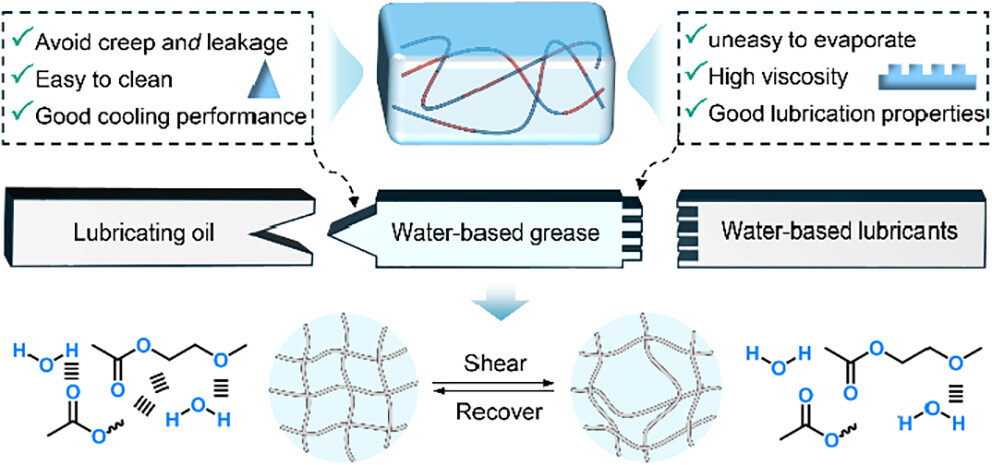
Compared with oil lubrication, water-based lubrication has attracted increasing attention owing to its low cost, ease of cleaning, and sustainability. However, the water-based lubricants suffer from inherent limitations, including low viscosity, inadequate lubricity, and susceptibility to metal corrosion. To address these challenges, we developed a novel water-based gel grease enabled by hydrogen-bond-driven self-assembly between gelators and water molecules, forming a stable gel network structure. The gelators are synthesized via free-radical copolymerization of poly(ethylene glycol) methyl ether methacrylate (PEGMA) and [2-(methacryloyloxy)ethyl] trimethylammonium chloride (METAC). The PEGMA ether chains impart high viscosity to the gelators, while METAC provides enhanced lubrication capability through quaternary ammonium cations. This design confers distinct shear-thinning and creep-recovery behaviors, effectively reducing lubricant crawl and leakage. Furthermore, tribological evaluations demonstrate a significant reduction in the coefficient of friction (COF) and wear volume (WV) compared to pure water, attributed to the formation of a durable tribofilm enriched with gelator-derived components that reduce interfacial shear and wear. Notably, the hydrogel exhibits exceptional corrosion inhibition and water-retention capabilities, preventing metal corrosion while enhancing operational durability. This work advances the mechanical design principles of water-based lubricants and expands their potential applications in environmentally sensitive and high-safety industrial settings.
Keywords Plus: TRIBOLOGICAL PROPERTIES,IONIC LIQUID
Published in ACS SUSTAINABLE CHEMISTRY & ENGINEERING,Volume14;10.1021/acssuschemeng.5c11328,FEB 16 2026