


Abstract
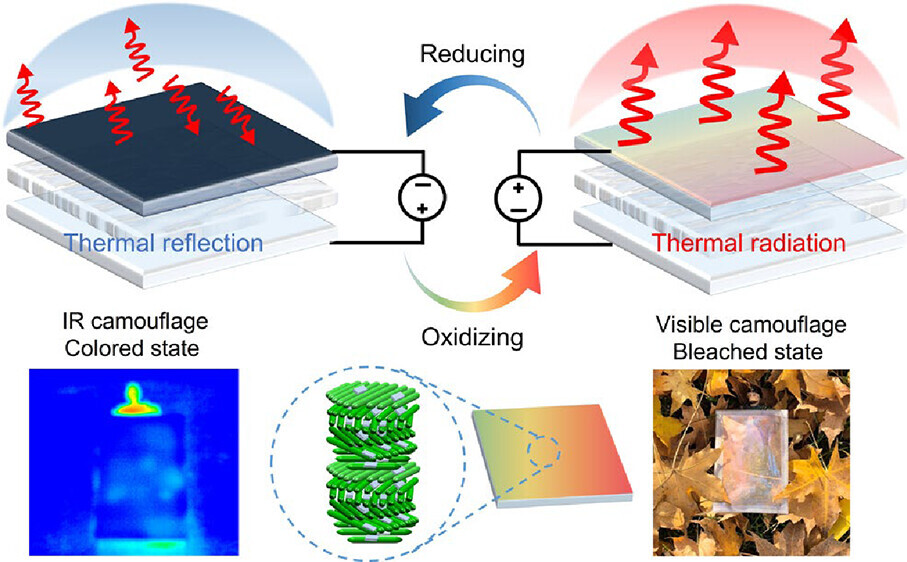
The rapid advancement of modern surveillance technologies brings significant challenges in achieving effective concealment for personnel, weapons, and equipment. Various visible or infrared camouflage materials have been developed to date, yet the integration of both visible and infrared spectra to achieve dual-band camouflage remains highly desirable, particularly in complex and dynamically changeable environments. This study presents an iridescent electrochromic platform using an in situ polymerization of 3,4-ethylenedioxythiophene (EDOT) onto cellulose nanocrystals (CNCs) and followed by evaporation-induced self-assembly. The CNC-PEDOT platform exhibits tunable infrared emissivity by adjusting the in situ doping content of PEDOT in CNC. More importantly, the infrared emissivity of the CNC-PEDOT platform can be in situ adjusted from 0.32 to 0.90 via voltage regulation, while simultaneously, the visible light transmittance of the CNC-PEDOT shifts from 1 to 70%, which bestows the CNC-PEDOT platform with the capability for adaptive visible-infrared dual-band camouflage in dynamic environments. As a proof-of-concept, test objects such as soldier and tank models, or even the human body, can be concealed in the background environment, regardless of whether they are in high- or low-temperature environments, by adjusting the applied voltage. Additionally, under visible light conditions, the test objects can also be camouflaged among backgrounds like fallen yellow leaves or gray rocks by adjusting the bleached or colored state of the CNC-PEDOT surface. The electrically controlled camouflage functionality of the CNC-PEDOT electrochromic platform is suitable in dynamic real-world environments, which underscores its potential as a wearable and adjustable intelligent camouflage material.
Keywords Plus: CELLULOSE NANOCRYSTALS,STABILITY,FILMS
Published in ACS APPLIED MATERIALS & INTERFACES,Volume18;10.1021/acsami.5c24670,FEB 25 2026