


Abstract
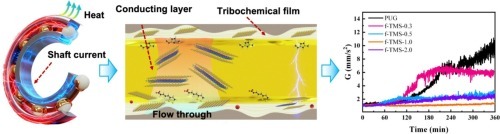
Electrical discharge-induced fluting and concurrent friction-wear remain critical failure modes for traction motor bearings in new energy vehicles, yet it is challenging to achieve low friction and high electrical erosion resistance simultaneously in grease lubrication. To mitigate electrical erosion and friction-wear damage in traction motor bearings of new energy vehicles, a hierarchically structured core-shell additive, DL-thioctic-acid-based ionic liquid functionalized Ti3C2Tx@1T-MoS2 (f-TMS), was developed and incorporated into a polyurea grease. Few-layer Ti3C2Tx MXene serves as a conductive core, vertically aligned 1T-MoS2 nanosheets form a lubricating shell, and a DL-Thioctic-acid-based ionic liquid (SSIL) is covalently grafted to improve 1T-MoS2 stability and interfacial affinity. FT-IR, XRD, SEM, TEM and XPS confirm the core-shell architecture and enrichment of metallic 1T-MoS2. Under SRV boundary conditions, greases with 0.5-1.0 wt% f-TMS show rapid running-in, a stable low friction coefficient (similar to 0.10) and an 84.8% reduction in wear volume versus neat polyurea grease. f-TMS decreases grease resistivity by more than four orders of magnitude. Bearing rig tests under 14 V AC demonstrate that 1.0 wt% f-TMS effectively suppresses fluting-type electrical erosion, reducing vibration acceleration to similar to 1.41 mm & centerdot;s(-2), while lowering operating temperature. A "lubrication-conduction-lubrication" conductive tribofilm, formed by SSIL-assisted Ti3C2Tx@MoS2 and metal sulfide/oxide/nitride tribochemical layers, enables cooperative lubrication and electrical erosion protection.
Keywords Plus: MOS2 NANOSHEETS,MONOLAYER,COATINGS,1T
Published in CHEMICAL ENGINEERING JOURNAL,Volume534;10.1016/j.cej.2026.175253,APR 15 2026