


Abstract
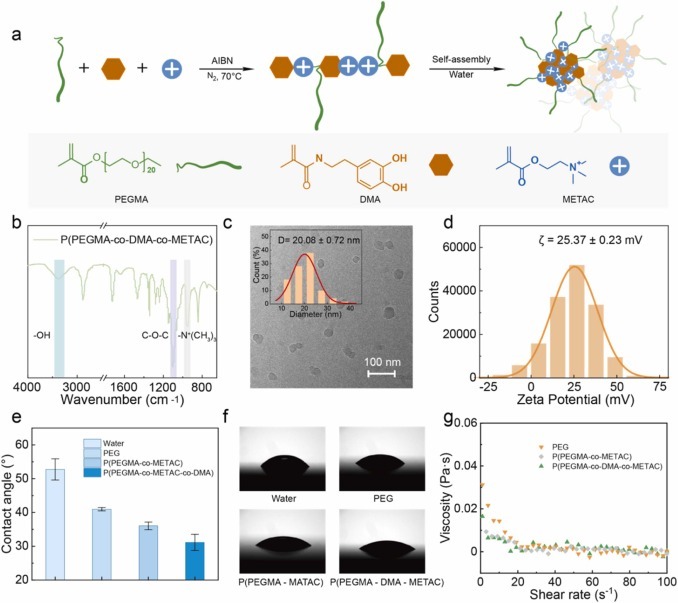
With growing demands for multifunctional biomaterials in biomedicine and medical devices, developing novel biolubricants that combine outstanding lubricity with antibacterial properties poses a significant challenge. In this work, a ternary copolymer P(PEGMA-co-DMA-co-METAC) was molecularly engineered by integrating three functional monomers: poly(ethylene glycol) methyl ether methacrylate (PEGMA) for improved rheology, dopamine methacrylamide (DMA) for strong interfacial adhesion, and [2-(methacryloyloxy)ethyl]trimethy-lammonium chloride (METAC) to confer antibacterial activity and hydration lubrication. The copolymer exhibited macroscopic superlubricity with an ultralow friction coefficient of similar to 0.0056 and negligible wear-in period, along with potent antibacterial efficacy against Staphylococcus aureus. Molecular dynamics simulations combined with experimental analyses revealed that the synergistic interactions among these components underpin its superior performance. This molecular design overcomes the single-function limitation of conventional biolubricants and provides a promising strategy for biomedical applications such as medical devices and artificial joints by simultaneously reducing friction and preventing infection, demonstrating both theoretical significance and clinical relevance.
Keywords Plus: ANTIMICROBIAL POLYMERS,MOLECULAR-DYNAMICS,WATER,IONS
Published in TRIBOLOGY INTERNATIONAL,Volume220;10.1016/j.triboint.2026.111950,AUG 2026