


Abstract
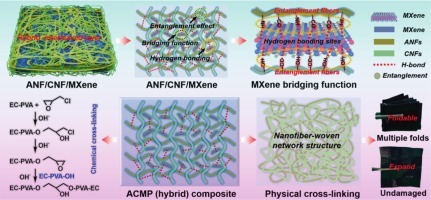
Traditional macro-fiber-reinforced polymer composites have long faced issues such as poor interfacial compatibility, stress concentration, and premature interfacial debonding, which stem from modulus mismatch between the reinforcing phase and the matrix, coupled with weak interfacial bonding. To address this issue, this study proposes and implements a MXene-induced micro-scale nanofiber weaving strategy. This approach utilizes MXene as a dynamic bridge to interweave rigid aramid nanofibers (ANF) with flexible cellulose nanofibers (CNF) at the microscopic level, forming ordered hybrid layers that are subsequently composite with polyvinyl alcohol (PVA) matrix. Through the synergistic interaction of hierarchical hydrogen-bond networks and chemical crosslinking with epoxychloride, continuous "rigid-hard-soft" gradient transition interface was successfully established within the composite material. This enables efficient stress transfer and multiscale energy dissipation, endowing the ACMP film with balanced strength-toughness tradeoff, manifested as synergistic improvements in strength, elongation at break, and fracture toughness. Furthermore, the storage and release mechanism of MXene within the ANF-CNF-MXene enables the progressive decrease in coefficient of friction with increasing loads, facilitating rapid stress transfer and energy dissipation at the micro-nano scale. Abundant noncovalent interactions between components (such as hydrogen bonds and van der Waals forces), significantly enhance interfacial compatibility and improving the flexible deformation capability of ACMP hybrid composites.
Keywords Plus: CELLULOSE
Published in CHEMICAL ENGINEERING JOURNAL,Volume535;10.1016/j.cej.2026.175617,MAY 1 2026