


Abstract
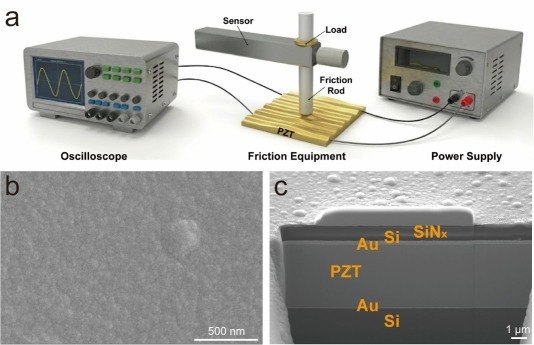
Electrical excitation vibration offers a route for active control of interfacial friction. In this work, friction and wear of SiNx films deposited on piezoelectric lead zirconate titanate (PZT) substrates are investigated under inverse piezoelectric excitation induced by an applied AC voltage. Reciprocating sliding tests against an Al2O3 ball are conducted with excitation voltages of 10-20 V and frequencies of 200-500 Hz. A pronounced voltage-selective optimum is consistently observed at 16 V, where the steady-state friction coefficient decreases to 0.15-0.17, corresponding to more than 60% reduction compared with non-optimal conditions. In contrast, static bias at the same voltage produces no friction reduction, demonstrating that dynamic electromechanical excitation governs the low-friction state. At the optimal voltage, inverse piezoelectric excitation simultaneously suppresses wear, leading to a reduction in wear-track width from 267 mu m to 102 mu m and a decrease in maximum wear depth from similar to 6-7 mu m to the sub-micron level, accompanied by reduced material transfer. These results show that inverse piezoelectric excitation can simultaneously suppress friction and wear in ceramic tribo-systems.
Keywords Plus: SLIDING FRICTION,REDUCTION,SCALE
Published in MATERIALS LETTERS,Volume414;10.1016/j.matlet.2026.140559,JUL 1 2026