


Abstract
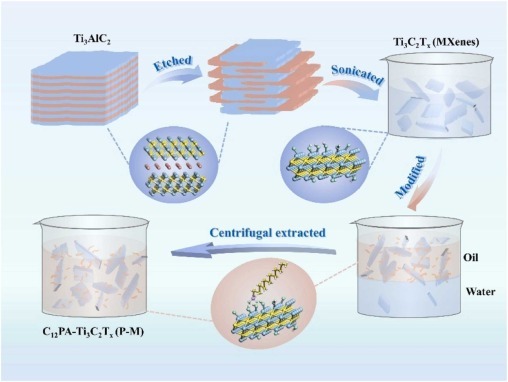
Two-dimensional MXene materials have demonstrated significant potential as lubricant additives in tribological applications. However, their lubrication mechanism in greases remains insufficiently explored. In this study, Ti3C2Tx MXene and dodecyl phosphate-modified lipophilic MXene (P-M) were synthesized. A one-step method was employed to prepare urea-based grease containing P-M. The effects of pristine MXene (M) and P-M on the rheological and tribological properties of the grease were systematically investigated. The results indicate that phosphorylation modification markedly improves the dispersion homogeneity and structural stability of the grease. Tribological tests show that the M additive exhibits excellent friction-reduction and anti-wear performance under low load (100 N), while the P-M additive demonstrates superior friction reduction, wear resistance, and load adaptability under medium-to-high loads (200 N, 300 N). The layered M contributes to friction and wear reduction through load-bearing capacity and partial oxidation to form a tribofilm. In contrast, the uniformly dispersed P-M nanoparticles form a robust composite tribofilm rich in TiO2 at the friction interface, which acts synergistically with the grease thickener to provide efficient and durable lubrication protection. This study offers new insights into the performance regulation and mechanistic design of MXene-based lubricant additives.
Published in TRIBOLOGY INTERNATIONAL,Volume221;10.1016/j.triboint.2026.111993,SEP 2026