


Abstract
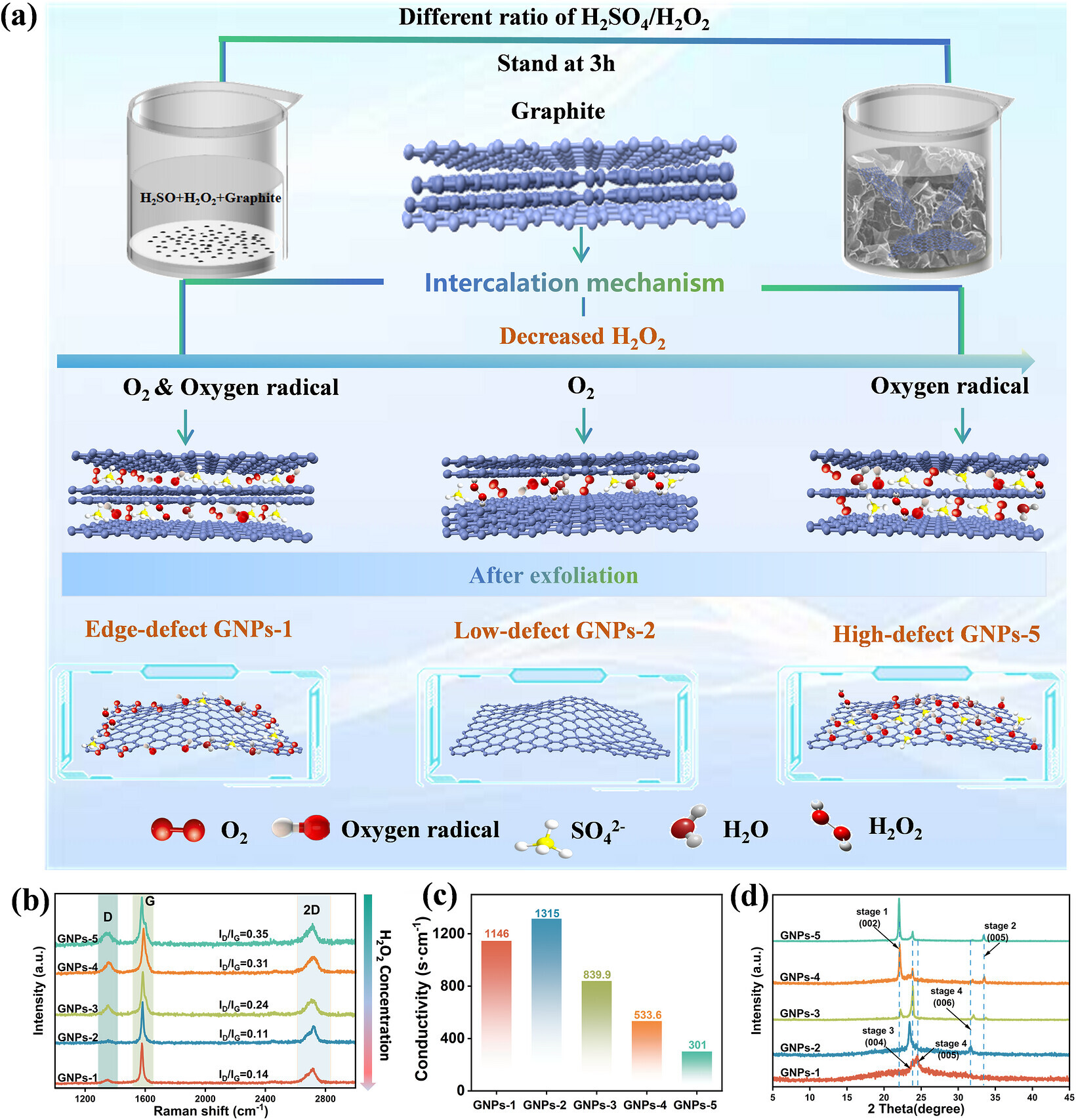
The increasing demand for multifunctional protection in miniaturized military equipment has driven the development of lightweight, high-efficiency microwave-absorbing (MA) materials with infrared stealth capability. However, achieving multispectral stealth involves complex component engineering and hierarchical architectures. Herein, we propose a simple strategy to modulate the graphitic structure of graphene nanoplatelets (GNPs) by constructing edge-defect GNPs featuring an in-plane conductive network and an out-of-plane amorphous architecture. Through a radical-mediated preferential edge oxidation process, the defect sites and their density are precisely controlled via the H2O2/H2SO4 disproportionation reaction. Edge-defects enhance polarization and impedance matching without interrupting the continuous in-plane conductive network, enabling microwave absorption and infrared stealth. The optimized edge-defect GNPs achieve a minimum reflection loss (RLmin) of -48.38 dB at a thickness of 1.46 mm, while a 5 wt% composite in silicone rubber achieves -40.6 dB at 1.5 mm, demonstrating a favorable balance of strong absorption, ultrathin thickness, and low filler content. Furthermore, the materials maintain low surface temperatures at 80 degrees C, 180 degrees C, and 200 degrees C, demonstrating excellent infrared stealth capability. This work provides an effective route for designing radar-infrared compatible stealth materials with simplified architecture and multifunctional performance.
Keywords Plus: PERFORMANCE,GRAPHITE,EXFOLIATION,MECHANISM,SHEETS
Published in SMALL,Volume22;10.1002/smll.202513716,JUN 2026