


Abstract
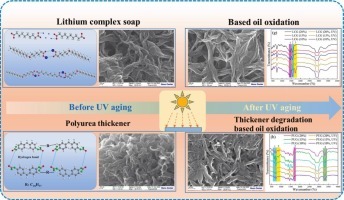
Greases used in aerospace applications are often subjected to ultraviolet (UV) radiation and elevated temperatures, which can compromise their structural integrity and lubrication performance. To develop UV-resistant lubricants suitable for long-term space operation, this study proposes a formulation-based design strategy by systematically tuning the thickener concentration (10, 15, and 20 %) in lithium complex grease (LCG) and polyurea grease (PUG). The effects of UV aging on their physicochemical, rheological, and tribological behaviors were investigated using FTIR, FE-SEM, rheometry, and XPS. Results reveal that UV aging leads to oxidative degradation of the base oil and microstructural damage to the thickener network, with severity dependent on the grease composition. While PUG (20%) exhibited the highest initial thermal stability due to its dense spiral fiber network, it suffered pronounced structural breakdown and oxidation upon UV exposure. In contrast, LCG, particularly with lower thickener content (10%), maintained better UV-aging resistance and superior tribological performance under high-load conditions, attributed to effective oil release and the formation of protective tribochemical films (Li2O). This study highlights the critical role of base oil-thickener interactions and network architecture in resisting UV-induced degradation and provides composition-performance guidelines for designing greases with enhanced aging resistance for aerospace and other extreme-environment applications.
Keywords Plus: TRIBOLOGICAL PROPERTIES,LUBRICATING GREASE,DEGRADATION,MECHANISM,RHEOLOGY,MODEL,FLOW
Published in JOURNAL OF INDUSTRIAL AND ENGINEERING CHEMISTRY,Volume158; 10.1016/j.jiec.2025.12.004,JUN 25 2026