


Abstract
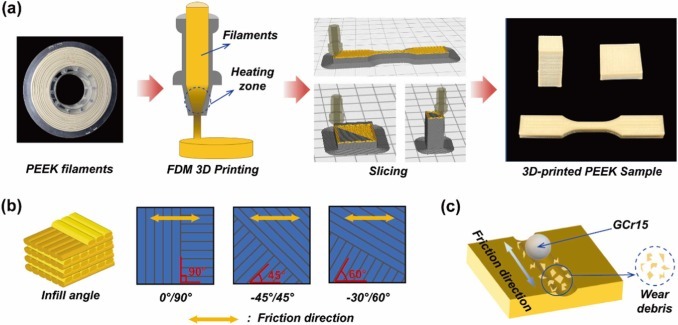
Poly(ether ether ketone) (PEEK) is increasingly used in fused deposition modeling (FDM) because of its thermoplastic processability, high-temperature capability, lightweight, excellent mechanical strength, and selflubricating characteristics. These advantages facilitate simple and cost-effective manufacturing of customized parts with complex shapes. The processing parameters play a crucial role in FDM-printed PEEK, and the optimized parameter selection can significantly enhance its overall performance. Accordingly, an orthogonal experiment was designed to investigate the effects of four typical printing parameters (the nozzle temperature, the infill angle, the layer thickness, and the printing speed) on the mechanical properties and tribological behaviors of FDM-printed PEEK. Based on range analysis, three optimal parameter combinations were identified to maximize the tensile strength and minimize the friction coefficient (COF) and wear rate. The influence of annealing post treatment on FDM-printed PEEK was further examined. Results show that annealing significantly increases the tensile strength of PEEK by 22.5%, while reducing its COF and wear rate by 35.3% and 55.0%, respectively. In particular, under a high load of 90 N, effective friction and wear reduction was achieved, with the COF decreasing nearly to 0.25 and the lower wear rate about 4.80 & times; 10-5 mm3/N & sdot;m.
Keywords Plus: TECHNOLOGY,QUALITY,IMPACT
Published in TRIBOLOGY INTERNATIONAL,Volume221;10.1016/j.triboint.2026.112069,SEP 2026