


Abstract
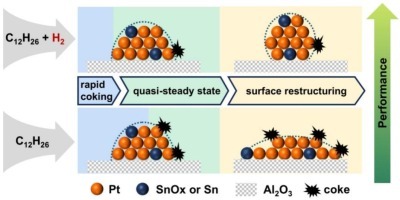
While the promoting effect of H2 co-feeding on light alkane dehydrogenation has been investigated, its role in long-chain alkane dehydrogenation, particularly the underlying mechanism, has not been systematically studied. Herein, we show the effect of H2 co-feeding on the evolution of surface species and the restructuring of active sites on Pt-based catalysts. During the reaction, not only carbonaceous species but also key reaction intermediates (olefinic/Pt complexes or early-stage aromatics) were observed. Based on the evolution of these surface species, the reaction can be divided into three stages: rapid coking, quasi-steady state, and surface restructuring. H2 co-feeding not only promotes olefin desorption, shortening the rapid coking stage, but also inhibits deep dehydrogenation of the intermediates. During restructuring without H2 co-feeding, the electron density of the active component decreases and its structure may transition from three-dimensional to raft-like structure, resulting in lower selectivity. In contrast, H2 co-feeding further enhances both the electron density and the alloying degree of the active component, thereby likely improving dehydrogenation activity. This work highlights the strong regulatory effect of surface adsorbates on catalytic reactions and provides deeper insight into the dehydrogenation mechanism.
Keywords Plus: PROPANE DEHYDROGENATION,CATALYSTS,HYDROGEN,ADSORPTION,PLATINUM,IR,DEACTIVATION,SPECTROSCOPY,PARTICLES,KINETICS
Published in CHEMICAL ENGINEERING JOURNAL,Volume537;10.1016/j.cej.2026.176409,JUN 1 2026