


Abstract
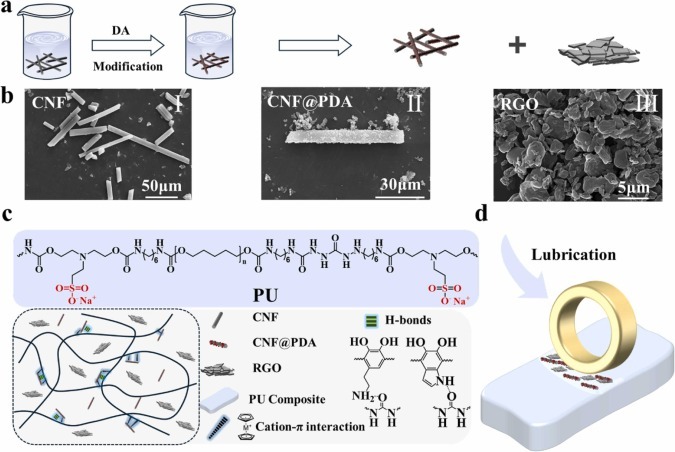
Solid lubricants often suffer from agglomeration and weak interfacial adhesion within polymer matrices, which limits their ability to effectively enhance tribological performance and thus restricts their practical applications. In this work, polydopamine (PDA)-modified carbon nanofibers (CNF@PDA) and reduced graphene oxide (RGO) were synergistically introduced into a polyurethane (PU) matrix to construct a high-performance tribological composite. The PDA coating on CNF provides abundant functional groups capable of forming hydrogen bonding and cation-pi interactions with PU molecular chains, thereby improving interfacial compatibility and structural stability of the composite. The tribological behavior of the composites was systematically evaluated using a highspeed water-lubricated ring-on-block tribometer. Under identical conditions (66 N, 0.54 m/s), the PU/ CNF@PDA/RGO composite exhibited a low friction coefficient of 0.0474 and a wear rate of 6.24 & times; 10-6mm3 / (N & sdot;m), corresponding to reductions of 48.7% and 30%, respectively, compared with pure PU. The enhanced performance is attributed to the synergistic effects of strengthened interfacial interactions and the solid lubrication provided by RGO. In addition, the CNF@PDA and RGO fillers were successfully recovered through hydrolysis and reused without significant deterioration in tribological performance. This study provides an effective strategy for designing high-performance and recyclable PU composites for water-lubricated tribological systems, with potential applications in deep-sea equipment and green marine vessels.
Keywords Plus: MECHANICAL-PROPERTIES,WEAR BEHAVIOR,FRICTION,CHEMISTRY
Published in TRIBOLOGY INTERNATIONAL,Volume222;10.1016/j.triboint.2026.112130,OCT 2026