


Abstract
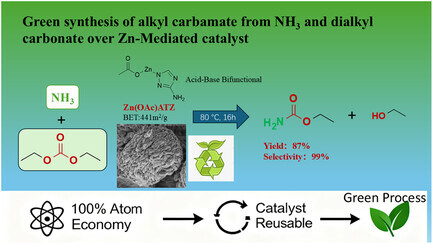
A series of zinc-acetate-triazolato catalysts (Zn(OAc)ATZ, Zn(OAc)TZ, Zn(OAc)TRZ, ATZ = 3-amino-1,2,4-triazolate, TZ = 1,2,4-triazolate, TRZ = 5-aminotetrazole) were developed for the direct synthesis of alkyl carbamates and corresponding alcohols from ammonia and dialkyl carbonates. Among them, Zn(OAc)ATZ exhibited exceptional catalytic performance due to its high surface area (441.11 m(2)/g), hierarchical porosity, and appropriate coordination environment. Under optimized conditions, 89% conversion of diethyl carbonate (DEC) with 88% ethyl carbamate (EC) yield could be achieved over Zn(OAc)ATZ at 80 degrees C for 16 h. For dimethyl carbonate (DMC), a remarkable 98% conversion and 97% methyl carbamate (MC) yield were obtained at 30 degrees C within 6 h, while dibutyl carbonate (DBC) required 24 h at 90 degrees C to reach 95% conversion and 93% butyl carbamate (BC) yield. Characterization of XPS and FT-IR revealed that the synergistic interaction between Zn-N bonds and carboxylate groups stabilized the active sites, enabling efficient substrate activation. The catalyst retained >87% activity after three cycles, demonstrating excellent stability in alkaline ammonia environments. This work provides a sustainable and industrially viable strategy for alkyl carbamate synthesis, aligning with green chemistry principles and the "dual-carbon" agenda.
Keywords Plus: DIMETHYL CARBONATE,DIETHYL CARBONATE,METHYL CARBAMATE,ETHYL CARBAMATE,ZINC ACETATE,1,6-HEXAMETHYLENEDIAMINE,UREA,HEXAMETHYLENE-1,6-DICARBAMATE,METHOXYCARBONYLATION,DECOMPOSITION
Published in CHEMSUSCHEM,Volume19;10.1002/cssc.70739,MAY 25 2026