


Abstract
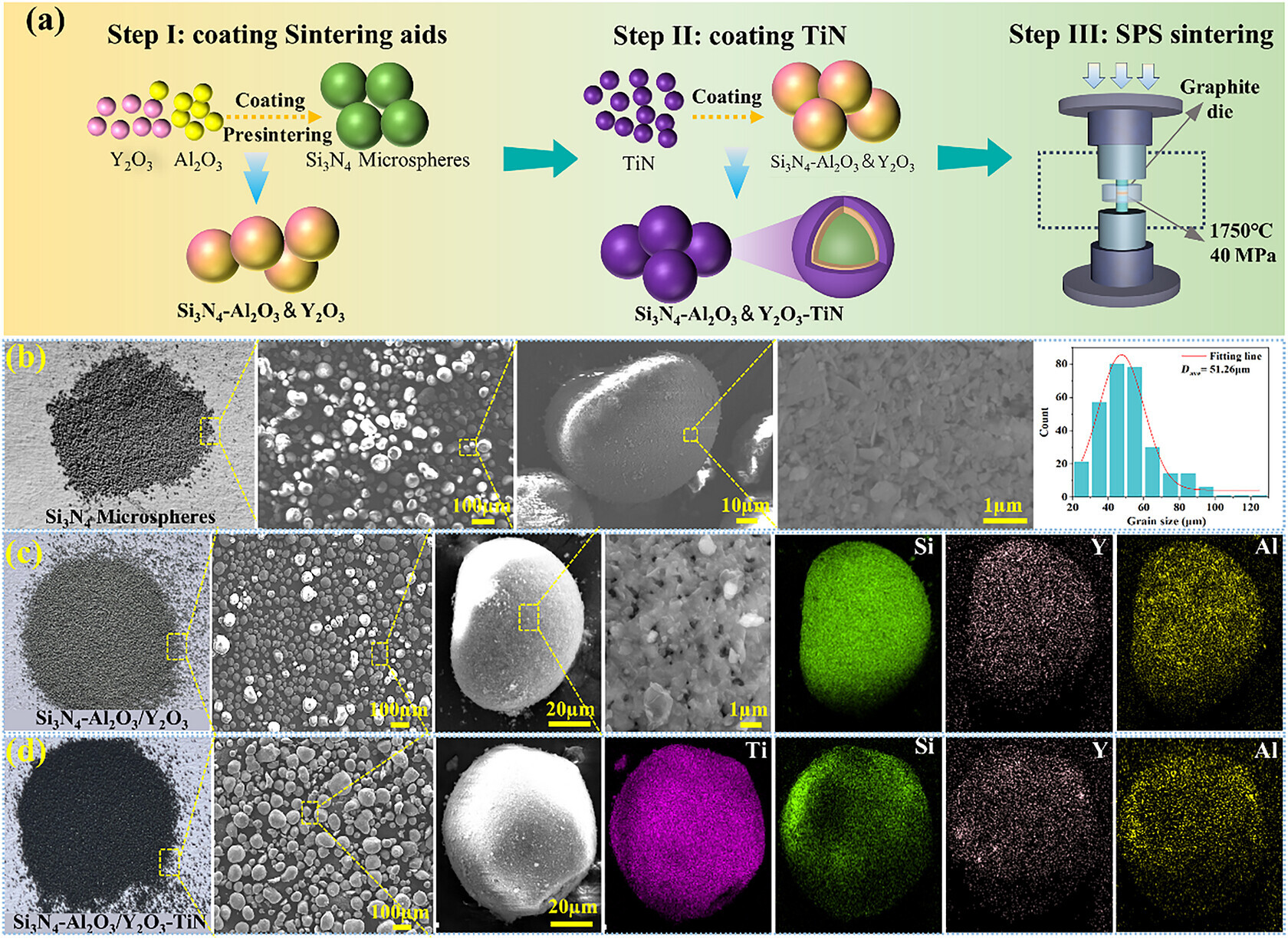
The functionalization of structural materials represents a critical trend in advanced ceramics. Herein, we report a three-dimensional network-reinforced Si3N4-TiN composite fabricated via a dry-mixing and spark plasma sintering strategy. This novel architecture enables continuous conductive pathways at an ultralow TiN content (5 wt%), synergistically enhancing mechanical properties, electrical conductivity, and electromagnetic interference (EMI) shielding. The composite achieves a flexural strength of 726.6 MPa and fracture toughness of 7.91 MPa & centerdot;m1/2, representing improvements of 22.6% and 70.1% over Si3N4. This enhancement arises from a synergistic mechanism involving crack deflection driven by the modulus gradient and the high dislocation density induced by residual compressive stress. Electrically, the TiN network elevates conductivity to 104 S/m, enabling the high-precision electrical discharge machining of complex geometries and excellent EMI shielding across the X-band (similar to 36 dB). This work provides a microstructure-guided strategy to overcome the strength-toughness-conductivity trade-off in ceramics, demonstrating structural-functional integration for harsh environments.
Keywords Plus: SILICON-NITRIDE CERAMICS,IN-SITU FORMATION,MECHANICAL-PROPERTIES,MICROSTRUCTURAL CHARACTERIZATION,RESIDUAL-STRESSES,SELF-LUBRICITY,COMPOSITE,NANOCOMPOSITES,TEMPERATURE,CONDUCTIVITY
Published in JOURNAL OF THE AMERICAN CERAMIC SOCIETY,Volume109;10.1111/jace.70902,JUN 3 2026