


Abstract
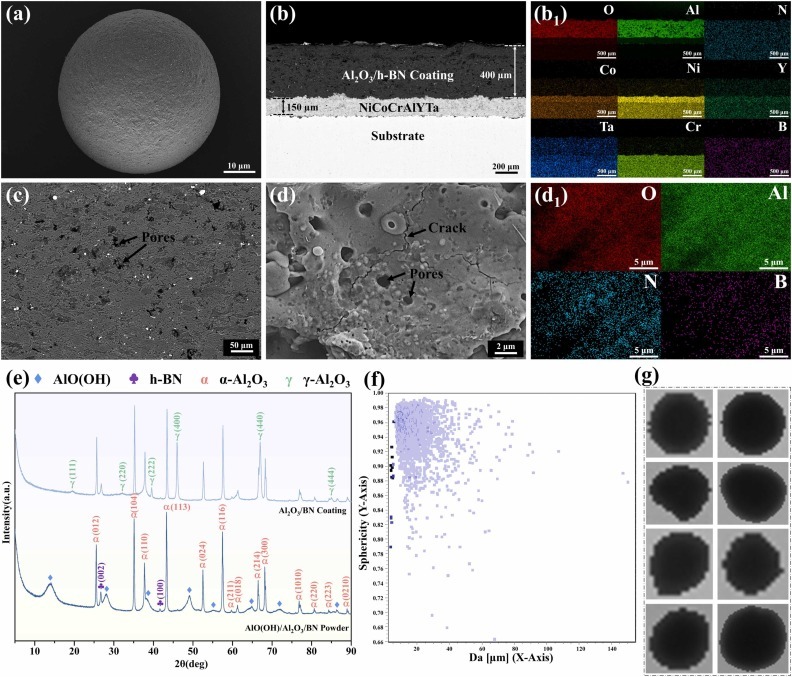
Aerospace equipment operating under extreme high-temperature conditions imposes stringent requirements on the self-lubricating and wear-resistant properties of ceramic coatings. Traditional graphite lubricating phases exhibit insufficient oxidation resistance at high temperatures, while existing studies on Al2O3/h-BN coatings lack a systematic understanding of tribological behavior across a wide temperature range. In addition, the agglomeration of h-BN further limits the improvement of coating performance. To address these challenges, hydroxylation modification was employed to eliminate the agglomeration of h-BN. Combined with a spray-drying process, highly spherical AlO(OH)/alpha-Al2O3/h-BN powders were prepared. Subsequently, Al2O3/h-BN coatings with uniformly distributed h-BN were fabricated using APS. The tribological properties of the coatings were systematically investigated over a wide temperature range from room temperature to 1000 degrees C. The results showed that the tribological performance of the coatings exhibited significant temperature dependence. At room temperature, shear action induced the exfoliation and spreading of h-BN, forming a dense solid lubricating film. At an extreme high temperature of 1000 degrees C, in situ generated low-viscosity liquid B2O3 formed a continuous liquid lubricating film, while the simultaneously formed high-hardness Al5BO9 phase provided strong mechanical support for the lubricating film, resulting in a solid-liquid synergistic lubrication mechanism. TEM characterization further revealed that the coating followed a "wear first, then film formation" lubrication mechanism at room temperature, whereas at 1000 degrees C it transformed into a "film formation first, followed by wear" protective mechanism. This study addressed a critical gap in the understanding of lubrication mechanisms of plasmasprayed Al2O3/h-BN self-lubricating coatings over a wide temperature range, and systematically elucidated for the first time a three-stage transition mechanism of "solid lubrication at room temperature - abrasive wear dominance at intermediate temperatures - solid-liquid synergistic lubrication at 1000 degrees C", providing important theoretical guidance and technical support for the design and engineering application of high-performance selflubricating coatings in extreme high-temperature environments.
Keywords Plus: BORON-NITRIDE NANOPLATELETS,SPRAYED CARBON NANOTUBE,WEAR BEHAVIOR,MECHANICAL-PROPERTIES,ALUMINUM-OXIDE,TEMPERATURE,MICROSTRUCTURE,CONDUCTIVITY,VISCOSITY,CERAMICS
Published in TRIBOLOGY INTERNATIONAL,Volume223;10.1016/j.triboint.2026.112275,NOV 2026