


Abstract
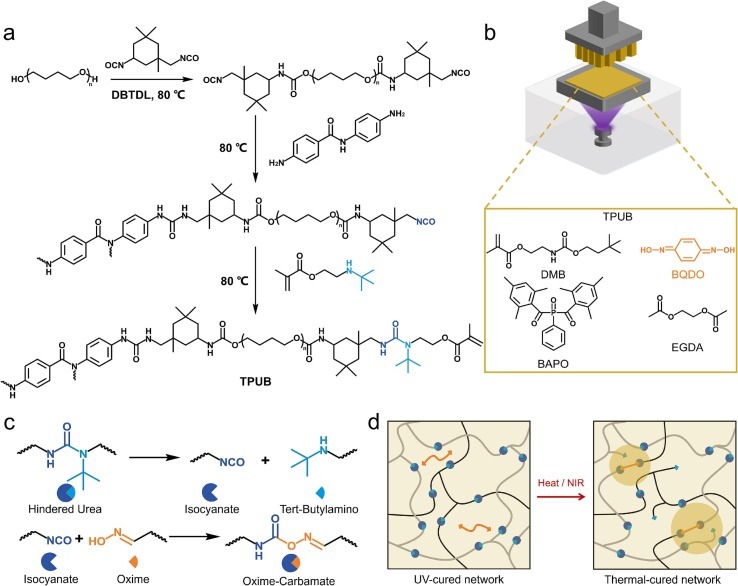
4D printing enables the creation of materials with precision architectures that evolve in shape or function over time, holding significant potential in fields like soft robotics and biomedical devices. However, achieving spatiotemporally controlled, high-performance multi-material systems remains challenging. Here, we introduce a strategy for the spatiotemporally controlled 4D printing of high-strength poly(urethane-urea) elastomers via topological reconfiguration. This is achieved by incorporating a side-chain carbamate monomer 2-(((3,3-dime-thylbutoxy(carbonyl)amino)ethyl methacrylate (DMB) and a photo-responsive extender p-benzoquinone dioxime (BQDO), which was introduced through hindered urea bond, it simultaneously enhances printability and introduces near-infrared (NIR) responsiveness. The post heating treatment significantly enhanced the mechanical performance of PUUB, increasing the tensile strength from 16.7 f 0.4 MPa to 27.0 f 1.3 MPa, and the toughness from 31.4 f 1.1 MJ/m3 to 72.4 f 4.4 MJ/m3. Additionally, it exhibited excellent shape memory performance, with a shape fixity ratio of 98.46% and a shape recovery ratio of 92.17%. Critically, the photothermal-triggered topological reconfiguration allows for remote, selective modulation of material properties after printing, enabling spatiotemporal control over the final performance. By incorporating a photothermal compound into the polymer, dynamic bond exchange remains inactive under UV irradiation during DLP printing but can be remotely and locally activated by NIR light. This enables spatially selective property programming, and the photo-thermally responsive regions further allow multi-responsive shape memory behavior for spatiotemporal actuation. This work represents a new paradigm for creating versatile, high-performance multi-material 4D systems for advanced applications.
Keywords Plus: POLYURETHANE ELASTOMERS
Published in CHEMICAL ENGINEERING JOURNAL,Volume543;10.1016/j.cej.2026.178573,SEP 1 2026