


Abstract
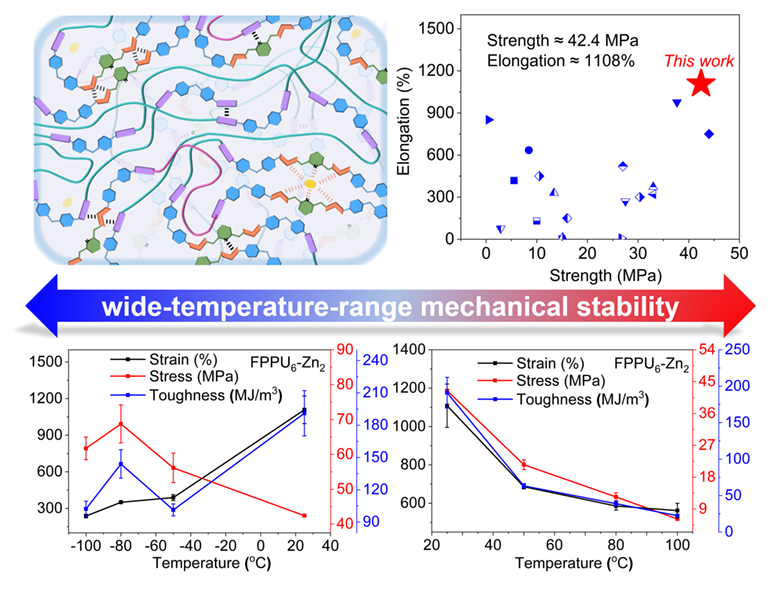
Elastomers with mechanically stable performance over extreme temperatures are urgently demanded for deep-space exploration, such as load-bearing components in lunar rovers. However, conventional elastomers suffer from cryogenic brittleness and high-temperature degradation. Herein, we report a polyurethane, FPPU6-Zn2, with exceptional mechanical strength and toughness across a broad window from -100 to 100 degrees C, by integrating two soft segments with multiple hydrogen bonds and metal-ligand coordination. At room temperature, it delivers a tensile strength of 42 MPa and toughness of 191 MJ/m3; it retains considerable strength at 100 degrees C; and at -100 degrees C, it achieves a high strength of 62 MPa and toughness of 102 MJ/m3, together with excellent flexibility even after immersion in liquid nitrogen. The synergy of hydrogen bonding and metal coordination promotes a favorable microphase-separated structure, which underpins the wide-temperature stability and also confers high stress retention and outstanding fatigue resistance under cyclic loading at 200% strain. This work offers a viable design strategy for elastomers that maintain mechanical integrity under harsh conditions, with promising implications for sealing applications in extreme environments.
Published in ACS APPLIED MATERIALS & INTERFACES;10.1021/acsami.6c13907