


Abstract
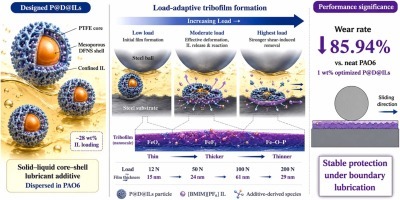
Solid-liquid core-shell particles are promising lubricant additives, however, the load-dependent interfacial response and tribofilm evolution of porous solid-liquid composite additives under boundary lubrication remain insufficiently understood. In this study, PTFE@DFNS@ILs particles, consisting of a polytetrafluoroethylene (PTFE) core, dendritic fibrous nanosilica (DFNS) mesoporous shell, and confined [BMIM][PF6] ionic liquids, were evaluated as additives in PAO6 base oil. At an optimized concentration of 1 wt%, P@D@ILs significantly improved the tribological performance of PAO6, resulting in smoother worn surfaces and a maximum wear-rate reduction of 85.94% compared with neat PAO6. Compared with PTFE, nSiO2, ZDDP, and physically mixed control formulations, P@D@ILs exhibited enhanced friction reduction and wear protection under the investigated boundary lubrication conditions. SEM-EDS, XPS, and FIB-TEM analyses revealed a pronounced load dependence of tribofilm formation. The local tribofilm increased in thickness from low to moderate loads and became thinner at the highest load, indicating a competition between tribofilm formation/compaction and shearinduced removal. XPS and cross-sectional analyses showed that the tribofilm contained FeOx, FeF2, Fe-O-Prelated species. The combined results support a possible load-adaptive lubrication mechanism involving the interfacial participation of confined ILs-derived species, possible mechanical response of the composite particles, tribochemical interactions, and development of a protective tribofilm. These findings provide mechanistic insight into the design of solid-liquid composite additives for boundary-lubricated steel contacts.
Keywords Plus: SILICA NANOPARTICLES,NANOSPHERES
Published in TRIBOLOGY INTERNATIONAL,Volume227;10.1016/j.triboint.2026.112838,MAR 202